What ever happened to… the TAG Heuer Mikros
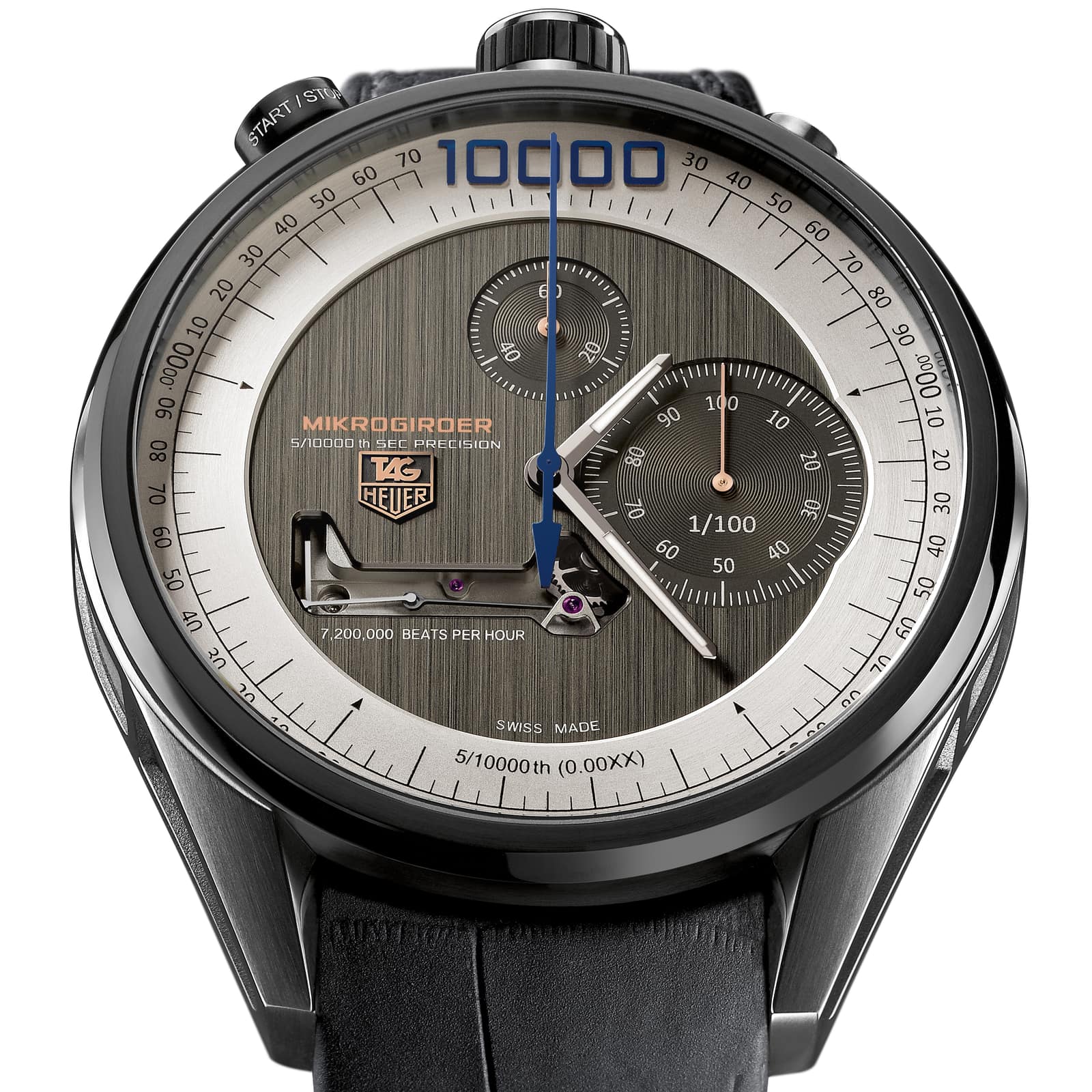
While researching my recent post on the TAG Heuer carbon balance spring, some of the TAG Heuer "Mikro" models cropped up. They hark back to a period when the brand was chasing high frequencies and saw the precision of its chronographs leap from 1/100th of a second to 5/10,000ths of a second in barely a year. Two of them also won prizes at the Grand Prix d'Horlogerie de Genève (GPHG), including the Aiguille d'Or. Here's how it went.
The Mikros at a glance
| Model | Reads to | Chronograph runs for | At the GPHG |
|---|---|---|---|
| Carrera Mikrograph (2011) | 1/100th of a second | 90 minutes | Entered 2011 |
| Mikrotimer Flying 1000 (2011) | 1/1000th of a second | 150 seconds | Sports Watch, 2011 |
| Mikrogirder (2012) | 5/10,000ths of a second | About 4 minutes | Aiguille d'Or, 2012 |
| Carrera MikroPendulum Tourbillon (2014) | 1/100th of a second | n/a | Shortlisted, 2014 |
1/100th of a second: the TAG Heuer Carrera Mikrograph (January 2011)
Unveiled as a limited run of 150 pieces, the Mikrograph solved the 1/100th-second problem with two separate balance wheels sharing one case. A conventional 28,800 vph (4Hz) balance ran the watch, while a second balance dedicated to the chronograph oscillated at 360,000 vibrations per hour (50Hz). That is fast enough for the central chronograph hand to complete one full rotation per second, so it reads hundredths directly. An even rarer Monaco-cased unique piece, lot 34 at Only Watch 2011, sold for EUR 44,000 against an estimate of EUR 50,000–70,000.
The power reserve for timekeeping was a relatively modest 42 hours (not enough for a "weekend watch"), but the 50Hz gear train for the chronograph consumed so much energy that it could only run for 90 minutes. The watch was entered in the 2011 GPHG but did not make the shortlist.
Its original retail price was CHF 50,000. At the time of writing you can pick one up for CHF 18,000 on Chrono24. For the technical detail, see WorldTempus's launch report.
1/1000th of a second: the TAG Heuer Mikrotimer Flying 1000 (2011–2013)
The follow-up pushed the same dual-gear-train idea an order of magnitude further: 1/1000th of a second, via a chronograph escapement running at 3.6 million vph. TAG Heuer branded the mechanism the "Launcher-Hub-Brake" system, a specialised-alloy hairspring paired with a perforated aluminium wheel. The central chronograph hand does ten full rotations per second for thousandths, a second hand tracks five-second blocks, and a subdial at 6 o'clock shows tenths.
With even greater demands on energy, the chronograph power reserve dropped to just 150 seconds. TAG Heuer's own marketing line was that it was "enough for one Formula 1 lap" (but not enough for a soft-boiled egg). The standard timekeeping stuck with the same 28,800 vph and 42-hour power reserve. Only 11 were made, at CHF 100,000 each. The Mikrotimer was the Mikro that the GPHG jury rewarded first, with the Sports Watch prize in 2011. WorldTempus and Watches by SJX both covered it in detail.
5/10,000ths of a second: the TAG Heuer Mikrogirder (January 2012)
The most radical of the Mikro family dispensed with the balance wheel altogether. It was only ever a prototype. The oscillating wheel and spring were replaced by a linear metal blade oscillator, similar to a tuning fork, vibrating at a staggering 1,000Hz (7.2 million vph). That is roughly 250 times the frequency of a standard watch, and it resolves 5/10,000ths of a second. The trade-off was severe: the chronograph power reserve was only around four minutes.
TAG Heuer's then-CEO Jean-Christophe Babin was explicit that there were "no plans for a commercial Mikrogirder", describing it instead as a technology showcase built for VIP retailers, though he left the door open to a small special-order run for select clients if demand emerged. It never happened. But the Mikrogirder was submitted to the GPHG in 2012 with an indicated retail price of CHF 150,000 and walked away with the Aiguille d'Or, the competition's top prize. The same year's GPHG edition also saw the MikroTourbillonS (CHF 220,000) shortlisted. A Blog to Watch has a hands-on, and Europa Star reported the prize.
The MikroPendulum: a less energy-hungry innovation
Continuing the research into replacing the trusty balance spring, the girder was followed by the pendulum, a technology as old as the grandfather clock, miniaturised for the wristwatch.
With the balance spring gone, magnetic fields were no longer an issue. In fact, magnetism was used to power the oscillator. The opposing forces of two magnets excited the oscillator that regulated the chronograph at 360,000 vph (50Hz), while the timekeeping kept to a standard 28,800 vph. The technology was first seen in the TAG Heuer Carrera MikroPendulum and MikroPendulumS (with a double-magnetic tourbillon), presented at Baselworld in April 2013. A Blog to Watch and WorldTempus have the details.
The final Mikro model came the following year with the TAG Heuer Carrera MikroPendulum Tourbillon. It combined the world's first double tourbillon, pairing a conventional 4Hz mechanical tourbillon (for timekeeping, with a silicon hairspring) with a 50Hz magnetic tourbillon (for the chronograph). Its launch unfortunately coincided with the arrival of Jean-Claude Biver, who took the helm at TAG Heuer in December 2014 and promptly set about repositioning the brand toward entry-level and mid-range models. This CHF 400,000 flagship was one of the first casualties of that decision, although it was shortlisted in that year's GPHG. Watches by SJX later went up close with the CHF 400,000 TAG Heuer that never was.
What became of the Mikros?
The Mikros stopped where the physics did. Each leap in frequency cost another slice of power reserve, from 90 minutes to 150 seconds to about four minutes, which is why none of them became a mainstream product. Yet the line left a trail of prizes: a Sports Watch in 2011, an Aiguille d'Or in 2012 and a shortlisting in 2014. You can follow all of them in TAG Heuer's full GPHG record on our index and in the brand's Only Watch lots.
The brand's R&D energy then went into materials rather than frequency, a story picked up in TAG Heuer and the carbon balance spring: third time lucky?. For more on how the prize has treated expensive, ambitious watches like these, see the three most expensive timepieces ever entered in the GPHG.