Medley relay: the GPHG categories compared
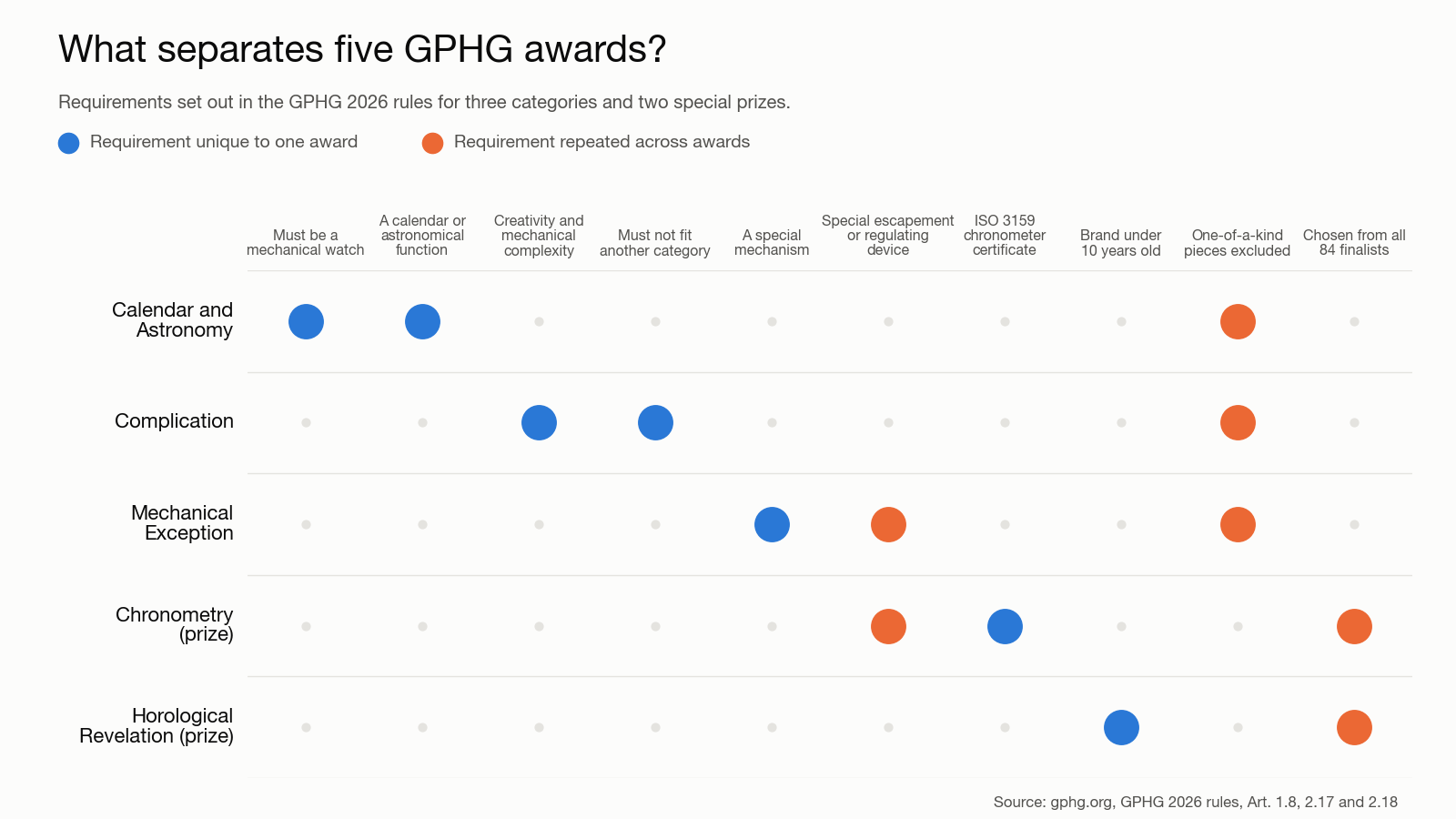
Three categories and two special prizes at the Grand Prix d'Horlogerie de Genève all reward clever, complicated and usually expensive watches. Read the rules closely and each one does have a point of its own, but the borders between them are porous.
At the Beijing Olympics in 2008, Michael Phelps won eight gold medals in the pool. Nobody doubts he was the best swimmer of his generation, but part of the arithmetic lies in the programme itself. Butterfly, freestyle, individual medley and relays overlap so much that the same exceptional athlete can win the same kind of race several times over. The shot-putters, with one event to their name, never stood a chance of matching him.
You might rightly be wondering what this has to do with watches. My suspicion, going into this piece, was that the Grand Prix d'Horlogerie de Genève has its own version of the medley. Calendar and Astronomy, Complication and Mechanical Exception are three of its 14 categories, and Chronometry and Horological Revelation are two of its special prizes. All five sound as though they reward much the same thing: a clever, complicated and probably expensive watch. A cynic (and I've been called worse) might conclude that they are a jumble designed to give high-end brands more chances to win.
So I read the official GPHG 2026 rules line by line, looking for what genuinely separates each one, and checked the results against the GPHG Index archive.
Calendar and Astronomy: defined by what it tells you
The official definition (Article 1.8) asks for a mechanical watch with at least one calendar or astronomical complication. The rules give a date, an annual or perpetual calendar, the equation of time and complex moon-phase displays as examples, and allow other indications on top.
The unique point: it is the only one of the five defined by a specific function, in other words by what the watch tells you. It is also the only one of the five to say explicitly that the watch must be mechanical.
The overlap: a simple date or a "classic" moon phase is also allowed in the Essential category, which only rules out Time Only, Complication and Gemset watches. The line between a classic and a complex moon phase is left to the brand's judgement. A perpetual calendar could just as easily be called a complication, and nothing stops a brand entering it in the new Complication category instead.
This year's prize went to Audemars Piguet's 150 Heritage, which costs a cool 2,702,500 Swiss francs (sorry, how much??? Did someone mix up their decimals with their thousands?).
Complication: defined by what it isn't
Complication is new for 2026, replacing the old Men's and Ladies' Complication categories, which had themselves replaced the Complicated Watch of the 2000s. Its definition asks for creativity and mechanical complexity, with complications and classic or innovative indications, and names world time and dual time as examples. Crucially, entries must not fall within the Essential or Mechanical Exception categories.
The unique point: it is the only one of the five defined largely by exclusion. It's the home for complicated watches (particularly the travel-time functions it names) that are too complicated for Essential but not special enough for Mechanical Exception.
The overlap: it excludes Essential and Mechanical Exception, but not Calendar and Astronomy, Tourbillon or Chronograph, whose definitions all allow extra complications. And "innovative indications" here sit awkwardly close to "innovative or sophisticated displays" in Mechanical Exception. "Creativity" is a fine quality, and an impossible one to check with a loupe.
The first winner was Cleguer's Inspiration One, at 103,020 Swiss francs, on the brand's first appearance.
Mechanical Exception: defined by how it works
The definition asks for a special mechanism, and lists innovative or sophisticated displays, automata, striking or other acoustic functions, special escapements, belt-driven movements and other original horological concepts.
The unique point: it is the only one of the five defined by how the watch works. In practice, it's where the striking watches and automata go, since no other category mentions sound or movement for its own sake.
The overlap: the special escapement it lists is the very same thing the Chronometry prize looks for, and its "sophisticated display" overlaps with Complication's "innovative indications".
This year's prize went to Blancpain's Grande Double Sonnerie, at 1.7 million Swiss francs (for the same money you could buy a Koenigsegg Gemera or a modest apartment in London).
Chronometry: the only one with a measurable test
Chronometry is a special prize (Article 2.18 of the rules), chosen from all 84 finalists, whatever category they were entered in. It rewards a watch that stands out for precision through a special escapement or regulating device, and that holds an official chronometer certificate to the ISO 3159 standard.
The unique point: that certificate. It is the only requirement among all five that can be objectively verified, with a pass mark and a piece of paper to prove it. Everything else depends on the eye of the beholder.
The overlap: the special escapement, again, which it shares with Mechanical Exception. And this year proved the point nicely: the Chronometry prize went to Ferdinand Berthoud's Naissance d'une Montre 3, which had been shortlisted in Mechanical Exception. That makes four Chronometry prizes for Ferdinand Berthoud from the eight awarded since 2018.
Horological Revelation: the only one about the brand
Horological Revelation is the other special prize (Article 2.17 of the rules), also chosen from all 84 finalists. Its sole condition is that the brand must be young, meaning that its first model went on sale less than ten years ago.
The unique point: it is the only one of the five that judges the brand. There is no technical requirement at all.
The overlap: none in the wording, although it shares the same pool of finalists as everything else. This year it went to Dominique Renaud's Pulse60, a finalist in Complication, at 52,969 Swiss francs.
Side by side
| Award | Type | Unique point of differentiation | Shared or overlapping requirements | 2026 finalists' price range (CHF) |
|---|---|---|---|---|
| Calendar and Astronomy | Category (Art. 1.8) | At least one calendar or astronomical function; must be mechanical | Date and classic moon phase also allowed in Essential; perpetual calendars could equally be complications | 32,700 to 2,702,500 |
| Complication | Category (Art. 1.8) | Defined by exclusion: not Essential and not Mechanical Exception; world time and dual time named | Innovative indications overlap with Mechanical Exception's displays; no exclusion of Calendar, Tourbillon or Chronograph | 28,800 to 164,312 |
| Mechanical Exception | Category (Art. 1.8) | A special mechanism: striking, automata, belt drives | Special escapement shared with Chronometry; displays overlap with Complication | 156,800 to 1,700,000 |
| Chronometry | Special prize (Art. 2.18) | ISO 3159 chronometer certificate | Special escapement or regulating device shared with Mechanical Exception | Any finalist |
| Horological Revelation | Special prize (Art. 2.17) | Brand's first model sold less than ten years ago | None in the wording | Any finalist |
So is it a jumble?
Partly. Each of the five does have a point of differentiation, and you can state it in a line: Calendar and Astronomy is about the function, Complication is about everything else that's complicated, Mechanical Exception is about the mechanism, Chronometry is about a certificate and Horological Revelation is about the brand's age.
The jumble lies in the absence of any precedence rule. Each model can only be entered in one category (Article 1.5), but the brand chooses which one, and a tourbillon perpetual calendar with an unusual display could legitimately go into any of three (Tourbillon, Calendar and Astronomy or Mechanical Exception). The special escapement appears in two awards, and so does the innovative display. Meanwhile, the special prizes are drawn from the same 84 finalists, so a strong shortlist gets several bites at the cherry. In 2026 the Mechanical Exception shortlist alone produced three prizes: its own, Chronometry for Ferdinand Berthoud and the Audacity prize for Konstantin Chaykin's ThinKing Mystery.
As for rewarding the high end, the evidence cuts both ways. The Mechanical Exception finalists averaged around 711,000 Swiss francs this year, and the cheapest was still 156,800, so that category is a playground for the haute horlogerie houses. Calendar and Astronomy averaged around 533,000. But the new Complication category averaged just 84,000, below even the Tourbillon finalists, and the Horological Revelation prize is reserved for young brands by definition. Its winners include Rémy Cools, Simon Brette and Anton Suhanov, hardly the industry's establishment.
So my first take was half right. The categories are porous, and Mechanical Exception in particular hands the most expensive watches in the competition more than one route to a prize. But the new Complication category and the Revelation prize do the opposite, which is probably the point of having them. For more on who actually wins, see the GPHG strike rate and the all-time prize table after 2026.
Michael Phelps, incidentally, would have made a fine Mechanical Exception entry: one special mechanism, eight ways to win!
Frequently asked questions
What is the difference between the GPHG Complication and Mechanical Exception categories?
Mechanical Exception is defined by a special mechanism, such as striking or other acoustic functions, automata, special escapements, belt-driven movements or unusual displays. Complication is defined largely by exclusion: it covers creative, mechanically complex watches (world time and dual time are named) that do not fall within Essential or Mechanical Exception. Both mention innovative displays, which is where they overlap.
What does the GPHG Calendar and Astronomy category require?
A mechanical watch with at least one calendar or astronomical complication, such as a date, annual calendar, perpetual calendar, equation of time or complex moon-phase display. Other indications are allowed, and one-of-a-kind pieces are excluded. It is the only one of these awards defined by a specific function.
Is Chronometry a GPHG category?
No. Chronometry is a special prize (Article 2.18 of the 2026 rules), chosen from all 84 finalists in any category. The winning watch must stand out for precision through a special escapement or regulating device and hold an official chronometer certificate to ISO 3159. Ferdinand Berthoud has won it four times since 2018, most recently in 2026 with Naissance d'une Montre 3.
Who can win the GPHG Horological Revelation prize?
Any of the 84 finalists from a young brand, meaning one whose first model went on sale less than ten years ago (Article 2.17). There is no technical requirement. Recent winners include Rémy Cools (2024), Anton Suhanov (2025) and Dominique Renaud (2026).
Can a watch qualify for more than one GPHG category?
Yes. The rules set no precedence between categories, and several definitions allow additional complications, so a watch can meet more than one definition. Each model may be entered in only one category, chosen by the brand. Special prizes such as Chronometry, Horological Revelation and Audacity are then awarded from all finalists, so a watch shortlisted in one category can also win a special prize.
Definitions are paraphrased from the official GPHG 2026 rules at gphg.org (Articles 1.5, 1.8, 2.17 and 2.18); follow the links for the full text. Prices and results are from the GPHG Index archive as of November 2026.