Who will win the GPHG 2026? I asked six AIs
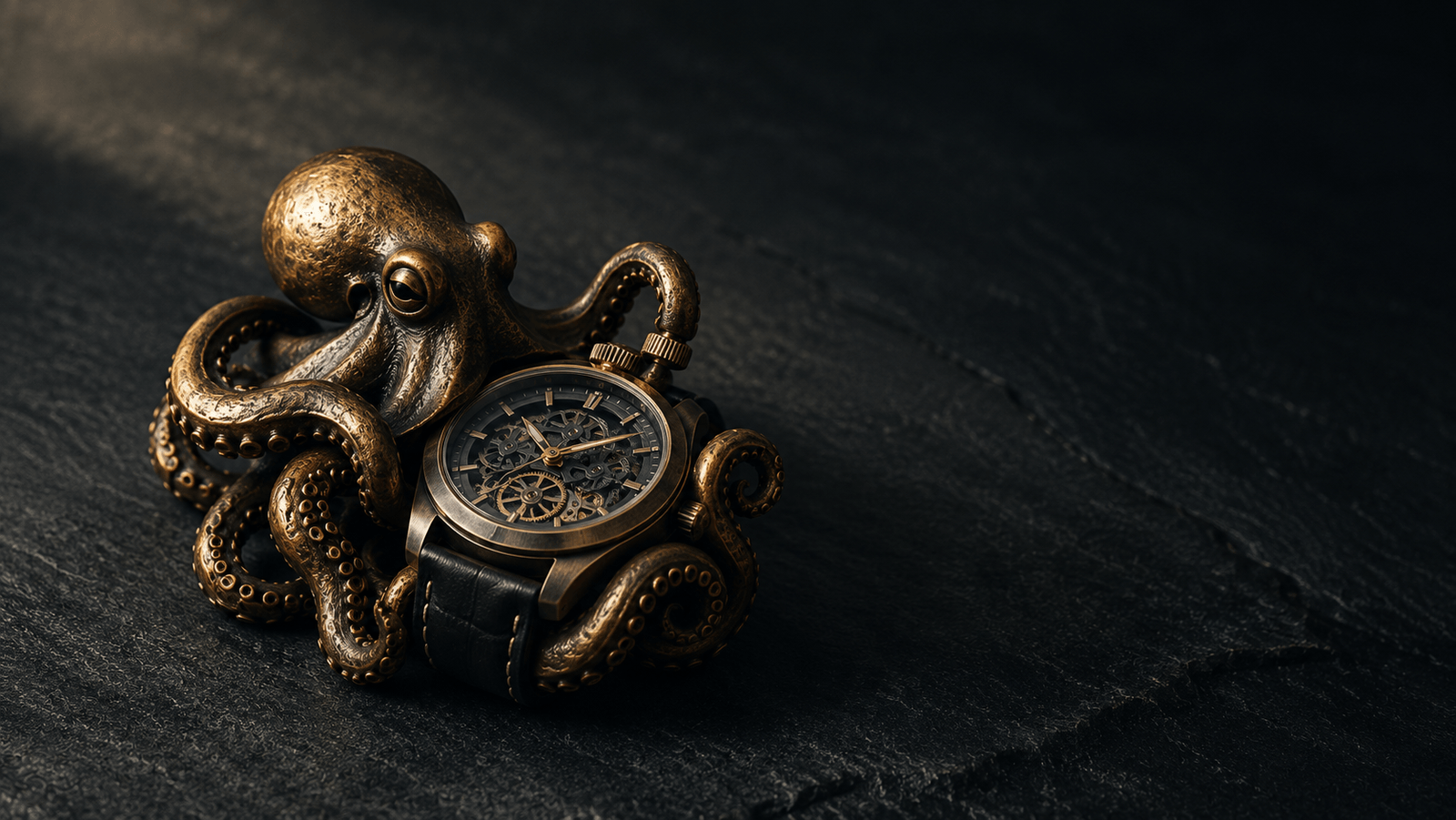
In the summer of 2010, the most trusted football pundit in the world was a common octopus in a tank in Oberhausen. Paul, as he was known, made his forecasts by choosing between two clear boxes lowered into his aquarium, each baited with a mussel and marked with a flag; whichever he prised open first was his tip. Across that World Cup he called all seven of Germany's matches correctly and then picked Spain to win the final — eight from eight. He was granted honorary Spanish citizenship, presented with a replica trophy, and, when he died a few months later, given an obituary in most of the world's newspapers. Nobody dwelt on the fact that an octopus cannot know the future, because that rather spoiled the fun.
You might reasonably wonder what a dead German octopus has to do with the rarefied world of the Grand Prix d'Horlogerie de Genève (GPHG). The answer is that on 14 September I sat down and put the horological version of "who wins the final?" to six of the world's leading AI models — who will win the GPHG 2026? — and watched them do, in prose, more or less what Paul did with a mussel.
Why the question can't be answered yet
The Grand Prix d'Horlogerie de Genève — the watch world's own Oscars — revealed its 84 nominated timepieces on 1 September: 78 watches and six clocks, drawn from 320 entries by 194 brands across fourteen categories. A jury of twenty-four, chaired for the first time by Wei Koh, will examine them in Geneva on 1 November, and the Aiguille d'Or — the top prize — is announced at the ceremony on 7 November, at the Bâtiment des Forces Motrices. The jury has not met. The debate is confidential. Nobody, the jury included, knows the winner. It is, in the purest sense, an unanswerable question — which is precisely why it is a good one to put to a machine built, above all else, to sound as though it has an answer.
I don't claim this is in any way scientific. It was less about watches and more about the (big) differences between the responses of AI models answering the same question. Some of the models could browse the live web and some could not; one or two know things about me from earlier conversations that the rest didn't. So take what follows as an honest record of what each actually said, not a league table of raw intelligence.
Which AI models predicted a GPHG 2026 winner — and which refused
The most revealing thing about each answer was simply whether the model was willing to pretend.
- Two declined outright, and were right to. Claude (Sonnet 5) and Grok both said, in effect, that the thing hasn't happened yet. Claude laid out the shortlist and offered to check back nearer the ceremony; Grok was blunter — "predictions are inherently speculative… past years have produced surprises" — and signed off with a flat "check back after November 7."
- One declined for the wrong reason. GLM-5.3 also refused, but on the false premise that the nominees "haven't even been announced" — when they had been, a fortnight earlier. A machine confidently wrong about a two-week-old fact anyone could check in thirty seconds is the entire anxiety about AI compressed into a single sentence.
- Kimi hedged, then cracked. "Officially, nobody can know," it began — before naming an early pick a paragraph later.
- Meta AI never named one winner but talked itself into a storyline: Audemars Piguet's technical daring against Chopard and Blancpain's tradition. That is a prediction wearing a dark trench coat.
- ChatGPT alone went the full Paul-the-Octopus: a ranked table with assigned odds, the Audemars Piguet RD#5 chronograph its favourite at 30%, and a closing line with no hedge in it at all — "my September 14 prediction."
Confidence is not evidence
Here is the one thing worth retaining: Across the six, a model's confidence and its actual command of the facts moved in opposite directions. ChatGPT was the surest of the lot — it put percentages on it — yet offered thinner underlying detail than either Meta AI or Grok. And the single most factually precise answer came from the one model that named no favourite whatsoever. Grok's specific, checkable claims — the exact fourteen categories in the GPHG's own running order, the exact nomination counts (Chopard with six; Audemars Piguet, Bulgari and Parmigiani Fleurier with four apiece) — matched the primary trade reporting in full, and it still declined to convert any of it into a tip. Hedging and rigour, it turns out, are not opposites. Here they arrived arm in arm.
None of which is new, of course. Philip Tetlock spent two decades demonstrating that the more confident and celebrated a human forecaster, the worse their calibration — the swaggering "hedgehogs" who know One Big Thing routinely beaten by the cautious, self-doubting "foxes." The machines have simply reinvented the result at scale.
What they were all reading
For all their differences, four of the six were drawing on the same spine of fact — the GPHG's own release — and, more tellingly, on the same trade press. Hodinkee and a named member of the 2026 jury surfaced independently in three separate answers; a governance detail — that the vote splits roughly one-third to the Academy, two-thirds to the jury — turned up independently in two more. When several models converge on the same specific reporting, what you are seeing is the shape of the real coverage underneath them.
Meta AI also confidently referred to a data-driven model called by Free Sprung which supposedly rebuilt twenty-five years of GPHG decisions and correctly flagged 55 of 84 nominees last cycle. They have even published password-protected PDFs with their predictions, to prevent any accusations of fixing their results or trying to influence the vote. I don't think that last point holds much water, as the watch press have been doing nothing but analyse the short lists since they were announced, which is why the predictions of our own model (and the reasoning behind them) are published for all to see.
The tell at the end
One last pattern, because it's a good one. The two models that pushed hardest to keep me talking — GLM-5.3 with a menu of follow-up topics, Meta AI offering to build me "a one-page cheat sheet of all 84 finalists" — sit at opposite ends of the accuracy table. The two that gave the plainest, most fact-dense answers, Claude and Grok, offered no hook at all; Grok didn't so much as ask a question. A chatty sign-off, in other words, tells you nothing about whether to trust what came before it. If anything, the model keenest on a second date was the one that fumbled the first fact.
So who will win the GPHG 2026?
I'm not going to tell you, for the same reason Grok wouldn't: nobody can. What I will say is that this site runs its own prediction model on the GPHG, and it earns its keep precisely by refusing to do what ChatGPT did. It scores the whole field out of sample, shows its working, and when it graded its own 2026 shortlist forecasts it published the misses next to the hits — 43 of 84, not a figure a betting man would dress up. A model that tells you it might be wrong is doing something an octopus, and a chatbot with an odds board, never will.
Paul the octopus went eight from eight and died a hero. The truth, which nobody wanted at the time, is that a coin would have got four. The jury sits on 1 November; the Aiguille d'Or is announced on the 7th. Until then, anyone — silicon or cephalopod — who hands you a name is guessing. The honest ones just say so.
The GPHG 2026, in brief
When is the GPHG 2026 winner announced? At the awards ceremony on Saturday 7 November 2026, at the Bâtiment des Forces Motrices in Geneva. The jury examines the 84 finalists on 1 November; nothing is decided before then.
Who is the favourite for the GPHG 2026? There is no official favourite — the winner is chosen by a confidential jury vote that hasn't yet happened. Treat any "prediction" (mine, an AI's, a pundit's) as informed guesswork.
Can AI predict the GPHG winner? Not reliably. In this test the models that refused to name a winner were also the most factually accurate about the field. AI can summarise the shortlist; it cannot know the result before the jury does.
P.S. Hats off to ChatGPT for the title image, which is one of the best images it has generated for me so far.
Facts checked directly for this piece: Worldtempus, Haute Time, Watch Collecting Lifestyle, WatchPro and Europa Star, plus the official gphg.org.