Strength in numbers? Swatch Group, LVMH and Richemont at the GPHG 2026
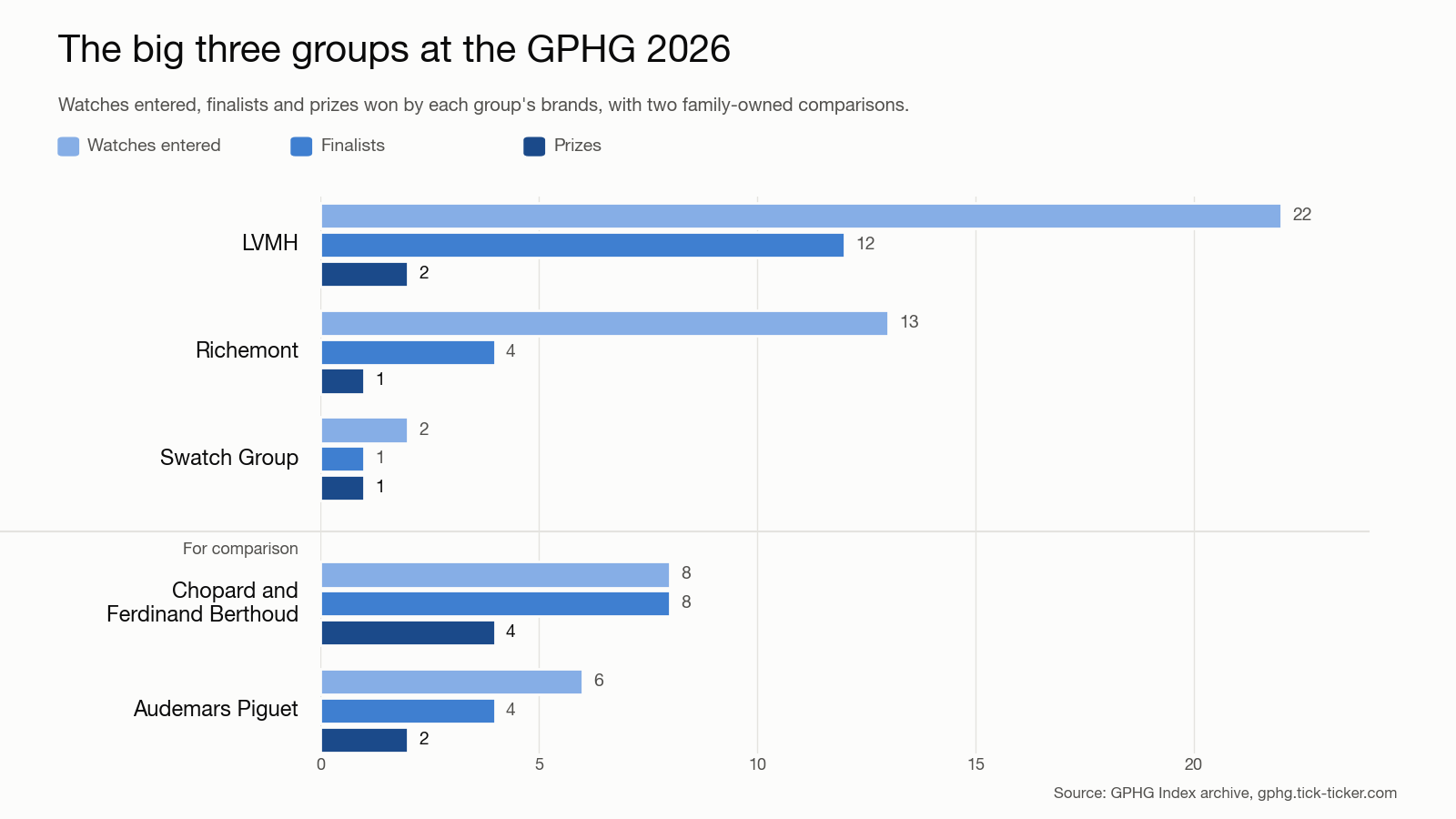
The three biggest groups in Swiss watchmaking sent 37 watches to the 2026 Grand Prix d'Horlogerie de Genève and came home with four prizes. One family's two brands won as many between them.
Formula 1 has two championships every season. The drivers' title gets the headlines, but the constructors' championship is the one the teams' accountants care about, because that's where the prize money is. A team with two good cars and deep pockets can win it without either driver ever standing on the top step of the podium. Consistency and scale count for a lot.
You might rightly be wondering what this has to do with watches. The Grand Prix d'Horlogerie de Genève only runs a drivers' championship: prizes go to individual watches and the brands that make them. But most of those brands belong to someone, and three owners in particular dominate the Swiss industry: the Swatch Group, LVMH and Richemont. So I've run a constructors' championship of my own for the 26th edition, using the GPHG Index archive and counting each brand under the group that owns it today.
The 2026 standings
| Group | Watches entered | Finalists | Prizes | Prize-winning watches |
|---|---|---|---|---|
| LVMH | 22 | 12 | 2 | Daniel Roth Extra Plat Rose Gold Skeleton (Essential), Louis Vuitton Tambour Taiko Arty Automata (Artistic Crafts) |
| Richemont | 13 | 4 | 1 | Piaget Swinging Pebble (Gemset) |
| Swatch Group | 2 | 1 | 1 | Blancpain Grande Double Sonnerie (Mechanical Exception) |
| All three groups | 37 of 320 | 17 of 84 | 4 of 20 | – |
Between them, the three groups entered 37 of the 320 watches in the competition, about one in nine. They did rather better at the nomination stage, with 17 of the 84 finalists, and took four of the 20 prizes. None of them won the Aiguille d'Or, which went to the independent Rexhep Rexhepi for his Chronograph Flyback.
LVMH: plenty of runners, few winners
LVMH fielded by far the biggest team, with 22 watches from eight brand names: five each from Bulgari, Louis Vuitton and TAG Heuer (company profile), two each from Dior and Tiffany & Co., and one each from Daniel Roth, Gérald Genta and the Louis Vuitton x De Bethune collaboration. Twelve of them made the shortlist, one in seven of all the finalists, which is an impressive hit rate at the first hurdle.
Converting them was another matter. Daniel Roth won the Essential prize, its third prize in three years since LVMH brought it back from the dead, and Louis Vuitton won Artistic Crafts with an automaton that my prediction model had ranked sixth of six. The rest drew a blank. Bulgari put four watches on the shortlist and won nothing, despite being the model's favourite in three categories (Time Only, Gemset and Artistic Crafts). Hublot and Zenith, more than 200 entries between them since 2003, didn't enter at all.
Richemont: the big names stayed at home
Richemont's 13 watches came from just four brands: six from IWC Schaffhausen, four from Piaget, two from the newly independent-minded Minerva and one from Montblanc. Piaget did the heavy lifting, with three finalists and the Gemset prize for the Swinging Pebble (another watch the model had written off, fifth of six). IWC managed one finalist from six entries, and now has one prize from 77 watches entered since 2001 (admittedly an Aiguille d'Or).
What stands out is who wasn't there. Van Cleef & Arpels, the group's most decorated house with 15 prizes, sat this one out. So did Vacheron Constantin, which hasn't entered since 2021, and Jaeger-LeCoultre, A. Lange & Söhne and Cartier, which haven't entered for years. (Baume & Mercier, which Richemont sold to the Damiani Group in July, is no longer theirs to count.)
Swatch Group: one shot, one hit
The Swatch Group barely turned up. It entered two watches, a Longines HydroConquest that didn't make the shortlist and the Blancpain Grande Double Sonnerie, which won the Mechanical Exception prize on Blancpain's first appearance since 2015. One prize from two watches gives Biel a 50 per cent strike rate, the best of the three by a distance, if hardly the biggest sample.
There was a good reason for the low turnout at the top end. Breguet won the 2025 Aiguille d'Or, so this year it sat on the jury instead of competing. Omega, meanwhile, hasn't entered a watch since 2014.
The family firms
Now for the uncomfortable comparison. Chopard and Ferdinand Berthoud, both owned by the Scheufele family, entered eight watches between them. All eight made the shortlist and four won prizes: the Time Only and Jewellery prizes for Chopard, and the Tourbillon and Chronometry prizes for Ferdinand Berthoud. That's as many prizes as Swatch Group, LVMH and Richemont won put together, from fewer than a quarter of the watches. Audemars Piguet, still family-owned, won two from six, which extended its lead at the top of the all-time prize table.
The long view
One edition is a small sample, so here is the whole archive, from 2001 to 2026, again counting each brand under its current owner:
| Group | Watches entered | Prizes | Prizes per watch | Aiguilles d'Or |
|---|---|---|---|---|
| Richemont | 567 | 63 | 11.1% | 5 |
| LVMH | 641 | 44 | 6.9% | 2 |
| Swatch Group | 210 | 19 | 9.0% | 2 |
Richemont has been the most successful of the three, largely thanks to Piaget (16 prizes), Van Cleef & Arpels (15) and Vacheron Constantin (11), and it has five Aiguilles d'Or, more than LVMH and the Swatch Group combined. LVMH has entered the most watches and has the lowest strike rate, close to the 6.1 per cent average for the whole field. The Swatch Group has entered the fewest, and nearly two-thirds of its 19 prizes came from Breguet and Blancpain.
Together, the three groups account for a quarter of all the watches ever entered (1,418 of 5,846), a third of all the prizes (126 of 380) and nine of the 26 Aiguilles d'Or. That's a decent return. It's also a reminder that the GPHG is a competition brands choose to enter, and the groups' biggest guns increasingly choose to stay away.
So who wins my constructors' championship for 2026? On points, LVMH, with two prizes to one apiece for the others. On efficiency, the Swatch Group. On both counts, the Scheufele family beat the lot of them, which proves that in Geneva, at least, you don't need a big team to win the title!
Frequently asked questions
How did the Swatch Group, LVMH and Richemont do at the GPHG 2026?
Between them they entered 37 of the 320 watches, had 17 of the 84 finalists and won 4 of the 20 prizes. LVMH won two (Daniel Roth for Essential and Louis Vuitton for Artistic Crafts), Richemont one (Piaget for Gemset) and the Swatch Group one (Blancpain for Mechanical Exception). None won the Aiguille d'Or, which went to the independent Rexhep Rexhepi.
Which watch group has won the most GPHG prizes?
Richemont, with 63 prizes from 567 watches entered between 2001 and 2026, counting the brands it owns today, and five Aiguilles d'Or. LVMH's brands have 44 prizes from 641 watches and the Swatch Group's 19 from 210, with two Aiguilles d'Or each.
Why didn't Breguet compete at the GPHG 2026?
Breguet won the 2025 Aiguille d'Or with the Classique Souscription 2025. Under the GPHG rules, a representative of the previous year's Aiguille d'Or winner sits on the following year's jury, and the brand does not compete.
Which LVMH brands won at the GPHG 2026?
Daniel Roth won the Essential Watch prize for the Extra Plat Rose Gold Skeleton and Louis Vuitton won the Artistic Crafts Watch prize for the Tambour Taiko Arty Automata. Bulgari had four finalists and TAG Heuer two, but neither won.
Did a family-owned brand beat the big groups at the GPHG 2026?
Yes. Chopard and Ferdinand Berthoud, both owned by the Scheufele family, won four prizes from eight entries, as many as the Swatch Group, LVMH and Richemont combined. Audemars Piguet won two from six.
Figures are from the GPHG Index archive as of 11 November 2026. Each brand is counted under the group that owns it today, including brands acquired after they first entered. Collaborations are counted under the group brand that leads them. Prize counts include special prizes credited to a brand.